To write a difficult email you keep rewriting, draft the whole thing without rereading: set a 5-minute timer, write everything you need to say in plain words, and don't look back until it ends. Then cut it to the three things that matter, put the main point first, and send it after one read.
The apology to a client. The "I'm leaving" message to your manager. The reply to a friend you've owed for three months. Hard emails are short, but they take hours, because every sentence gets rewritten before the next one exists.
Why hard emails take so long
With a hard email you're not short of words. You're short of nerve. Each line gets judged as you write it: too blunt, too soft, too long. So you go back and adjust it, and the email never gets past the second paragraph.
A 15-minute plan
- Blind draft (5 minutes). Write everything you want to say, honestly and in plain words, without rereading. Don't write the greeting. Start with the hard part.
- Walk away (2 minutes). Get a glass of water.
- Cut (5 minutes). Read once. Keep the three things that matter. Put the main point in the first two sentences.
- Tone check (3 minutes). Read it as the recipient. Remove anything defensive. Add the greeting and sign-off. Send.
The same plan works for anything short and high-stakes: a resignation letter, an apology, a toast. For a speech, start by checking how many words fit with the speech length calculator. If you need a first line, the work writing prompts include "Write the hard message kindly and clearly" and "Write the apology without explaining yourself first."
Why blind drafting helps here
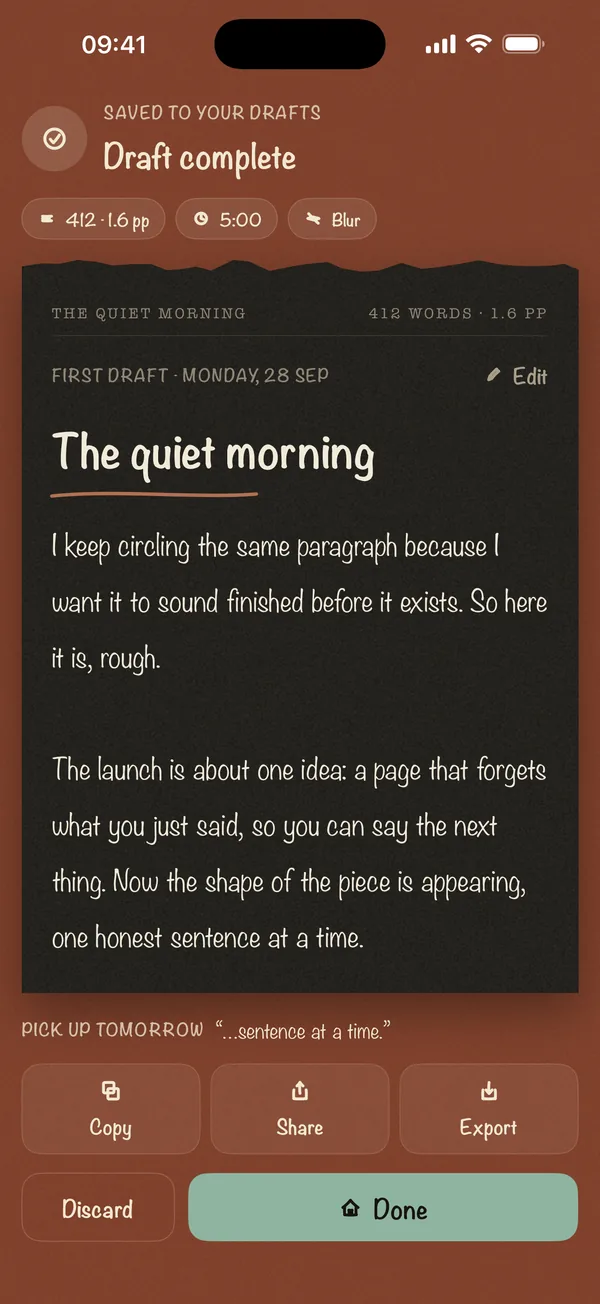
Hard emails stall because you can see what you just said and start doubting it. If you can't see it, you keep going. In Blind Draft, a 5-minute sprint in Invisible mode (Pro, with one free try) hides each line once you move on, so the whole message gets out before your inner editor catches up. The reveal shows you what you actually wanted to say, which is usually clearer than the version you'd have polished.
Frequently asked questions
How do I start a difficult email?
Skip the greeting and write the hardest sentence first, in plain words. You can soften it later. Starting with the main point gets the email written.
How long should a difficult email be?
As short as possible. Three short paragraphs: the main point, the necessary context, and the next step.
Should I sleep on a difficult email?
For emotional emails, yes. Write the blind draft now, edit and send tomorrow.