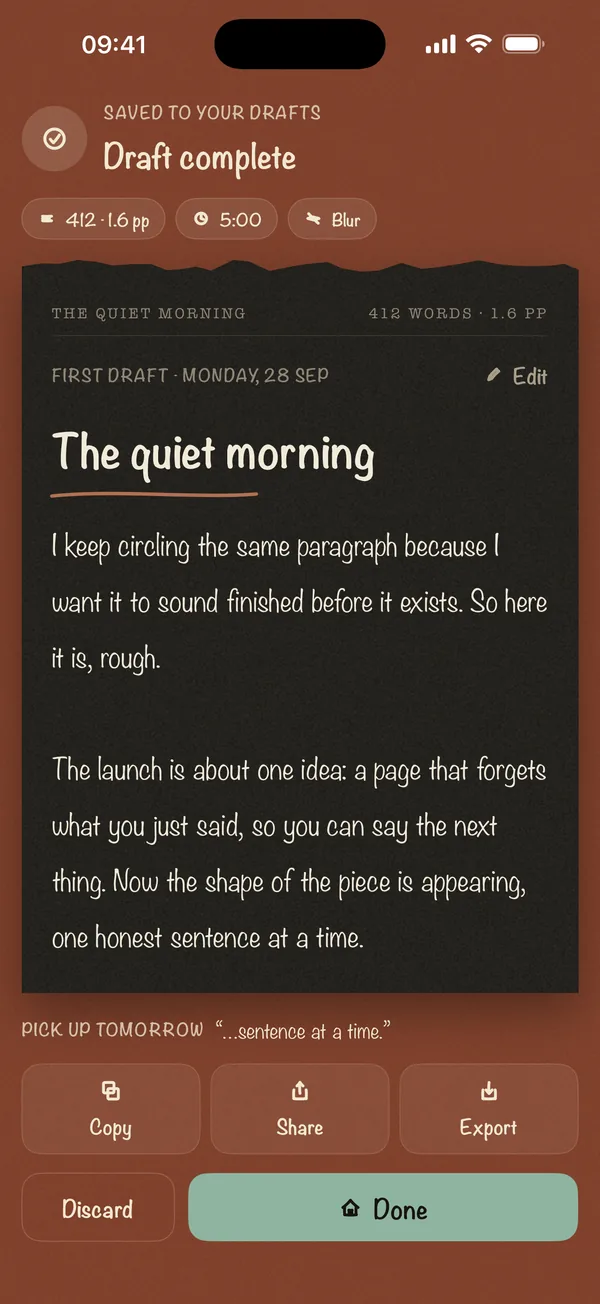
A freewriting prompt is a starting line or question that gets you writing without stopping for a set time, usually 10 minutes. Good ones are open-ended, such as "Write the part you already know" or "The thing nobody tells you about...". The rule is to keep writing even when the prompt runs out.
28 freewriting prompts
- Write the messy version first.Write it blind
- Stay with one idea for the next ten minutes.Write it blind
- Explain the thought before judging it.Write it blind
- Start in the middle and work outward.Write it blind
- Say it the way you'd say it out loud.Write it blind
- Write the part you already know.Write it blind
- Don't explain — just describe.Write it blind
- Finish the sentence you're afraid of.Write it blind
- The thing nobody tells you about my job is...Write it blind
- Right now I can hear...Write it blind
- What I really meant to say was...Write it blind
- I keep coming back to the idea that...Write it blind
- Write about the last thing you changed your mind about.Write it blind
- Describe the room you're in as if you'll never see it again.Write it blind
- Start with the words "I don't know what to write" and keep going.Write it blind
- Argue with something you read this week.Write it blind
- List ten things you'd write about if nobody would ever read them.Write it blind
- Write the first page of the project you keep avoiding.Write it blind
- What question have you been carrying around lately?Write it blind
- Describe an object on your desk, then tell its story.Write it blind
- Write about a smell that takes you somewhere.Write it blind
- If I had to explain my idea to a ten-year-old, I'd say...Write it blind
- Write the worst possible opening line for your next piece. Then keep writing.Write it blind
- What would you write if you knew it would be deleted in an hour?Write it blind
- The real problem is...Write it blind
- Write down everything you know about your topic, in any order.Write it blind
- What happens next?Write it blind
- Describe the moment just before something changed.Write it blind
The rules of freewriting
- Set a timer for 10 minutes. Five is fine at first.
- Don't stop moving until it ends.
- Don't reread or correct anything. Typos stay.
- If you get stuck, write that you're stuck until the next thought arrives.
Our full guide to what freewriting is covers the method's history and five longer exercises.
Sentence starters vs. questions
Sentence starters ("The real problem is...") get you typing in the first second, which is why they're good when you're cold. Questions ("What question have you been carrying around?") lead to more reflective writing. Use a starter to warm up, then a question.
The first eight prompts are the Focus pack from the Blind Draft app. They're instructions more than topics: they tell you how to write, not what to write about.
Make it impossible to edit
The hardest rule is "don't reread". If you can see the last sentence, you'll want to fix it. The free blind writing pad blurs or hides earlier sentences until the timer ends. For other tactics, see how to stop editing while you write.
Frequently asked questions
Do I have to stick to the prompt?
No. The prompt is only a way in. If your writing wanders, follow it. That's often where the useful material is.
Is freewriting the same as journaling?
They overlap. Journaling is usually about your life; freewriting can be about anything, including a project you're working on. Both work best without self-editing.