Most drafts don't fail for lack of ideas. They fail one backspace at a time.
You write a sentence. You reread it. You fix it. The paragraph above now sounds wrong, so you fix that too. An hour later there's one polished paragraph and no draft, and the next day the same thing happens to the same paragraph.
Writing and editing are different jobs
Writing asks you to make something that doesn't exist yet. Editing asks you to judge something that does. Doing both at once is like driving with the handbrake on: you move, but slowly, and it wears you out.
Writers have known this for a long time. Peter Elbow built a teaching method around freewriting: write without stopping, judge later. Anne Lamott told a generation of writers to give themselves permission to write bad first drafts. The advice is old and widely repeated, and it's still hard to follow, because the words you just wrote are sitting right there, asking to be fixed.
So we took the words away
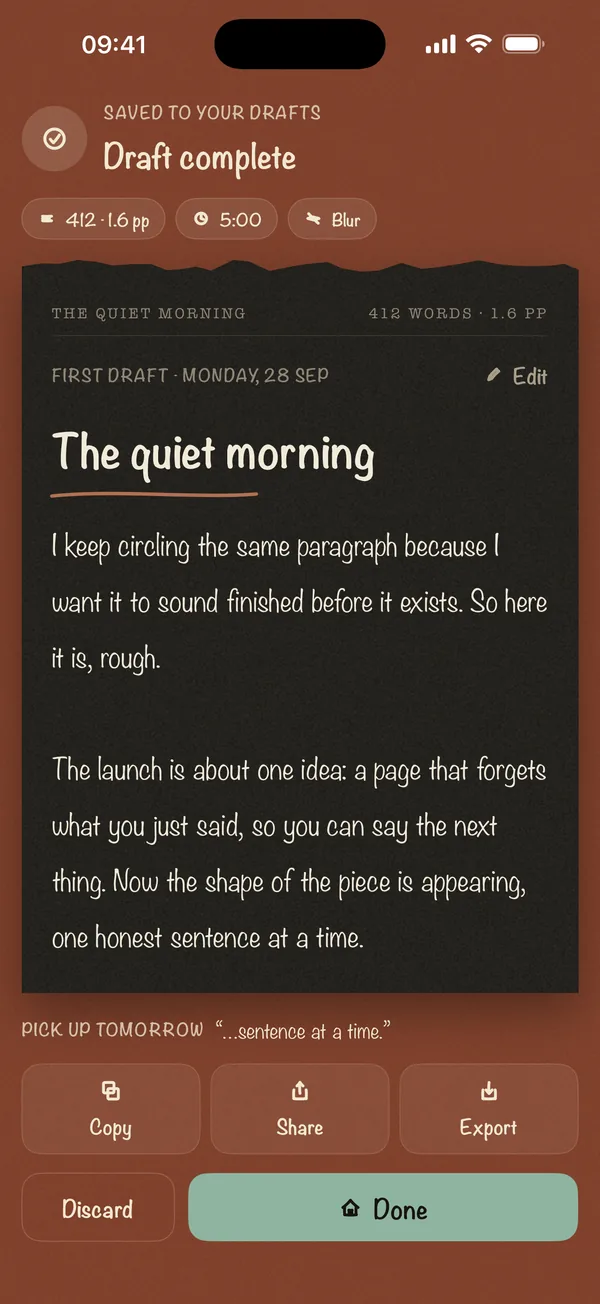
Blind Draft doesn't ask for willpower. It changes what you can see. While a sprint runs, the text behind your cursor is blurred, hidden, or reduced to the line you're on. There's nothing to reread, so there's nothing to fix. The only thing you can do is write the next sentence.
When the sprint ends, every word comes back. Nothing is deleted, nothing is punished. You get a complete, messy, honest draft, the kind that can actually be edited.
What we believe
- Done beats good, for the first draft. Quality is what editing is for.
- Small goals finish big things. Five minutes a day is a draft by Friday.
- Your drafts are yours. No account, no tracking, no server. First drafts are private by nature.
- Pay once. A writing tool shouldn't charge you every month to keep using your own words.