Freewriting is writing continuously for a set time, usually 5 to 15 minutes, without stopping, rereading, correcting spelling, or worrying about quality. If you get stuck, you write "I'm stuck" until the next thought comes. Writing teacher Peter Elbow popularized it in his 1973 book Writing Without Teachers.
Freewriting is the simplest writing exercise there is, and one of the most useful. You set a timer, you write without stopping, and you don't judge what comes out. That's the whole method.
The rules of freewriting
- Set a timer. 10 minutes is the classic length. 5 is fine to start.
- Don't stop moving. Keep your hands moving until the timer ends.
- Don't reread. Not a sentence, not a word.
- Don't correct anything. Typos, grammar and bad phrasing all stay.
- If you get stuck, write that you're stuck. "I don't know what to say next" counts. Repeat it until something else appears.
- Don't share it. Freewriting is private, which is why it works.
Where freewriting comes from
The term is most closely linked with Peter Elbow, an American writing teacher whose book Writing Without Teachers (1973) argued that most people write badly because they try to write and edit at the same moment. His fix was to separate the two completely: generate first, without judgment, then revise. Earlier writers suggested similar things. Dorothea Brande's Becoming a Writer (1934) recommended writing first thing in the morning before the critical mind wakes up. Later, Julia Cameron's "morning pages" turned the idea into a daily habit. See our guide to the morning pages habit.
Why freewriting works
- It gets past the blank page. The rule "don't stop" leaves no room to wait for the perfect first sentence.
- It separates writing from editing. You practice generating without judging, the skill most drafts lack. Our guide on how to stop editing while you write goes deeper on this.
- It finds what you think. Many writers discover their real point halfway through a freewrite.
- It builds speed. Regular freewriting makes ordinary drafting faster.
5 freewriting exercises to try
1. The 5-minute warm-up
Before any writing task, freewrite for 5 minutes about the task itself: "This essay is about... what I actually want to say is... the part I'm unsure about is..." It often produces your opening.
2. The focused freewrite (10 minutes)
Write one question at the top, like "Why did the project fail?", and freewrite on it for 10 minutes. This is sometimes called a focused or guided freewrite. When you drift, steer back gently.
3. The looping freewrite (3 × 5 minutes)
Freewrite for 5 minutes. Read it once and underline the most interesting sentence. Use that sentence as the starting line of the next 5-minute freewrite. Repeat three times. It's a quick way to go from a vague topic to a clear angle.
4. The blind freewrite (10 minutes)
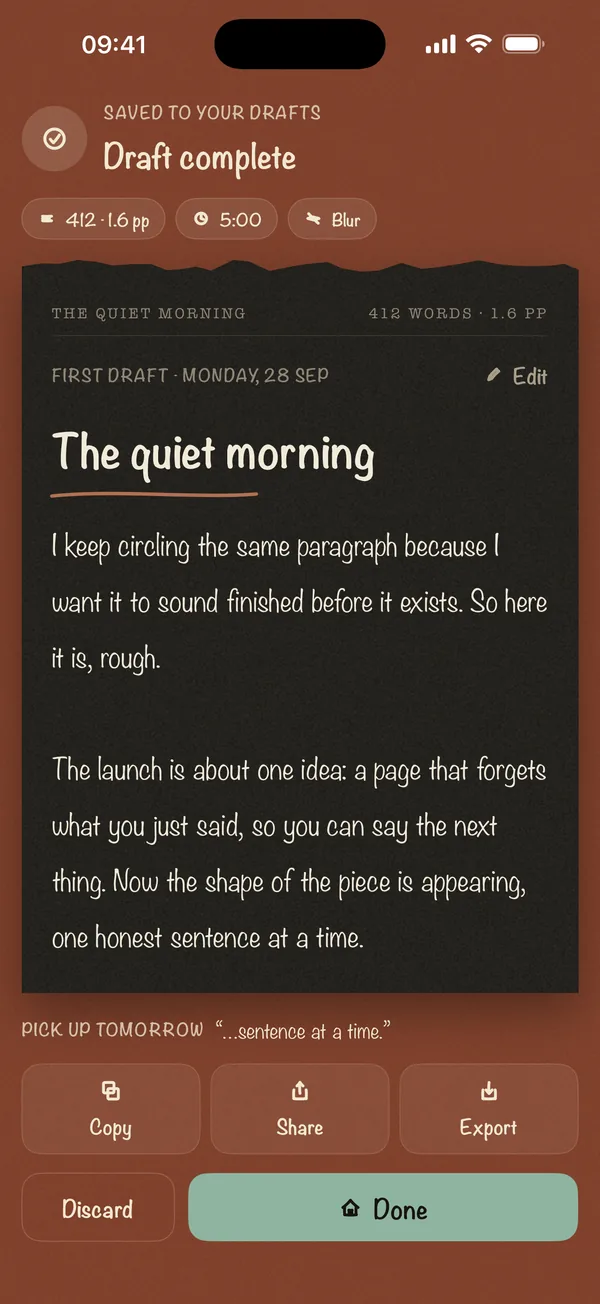
Freewrite with your earlier text hidden. This removes the last temptation, rereading, and is usually the fastest way for perfectionists to feel what freewriting is meant to be. You can do it on paper by folding each line under, or on iPhone and iPad with Blind Draft's Invisible mode.
5. The prompt freewrite (15 minutes)
Pick a prompt and write for 15 minutes without stopping. Good prompts are concrete: "a room you used to live in," "the email you didn't send," "what you'd do with a free Tuesday."
Freewriting vs other writing methods
| Method | Goal | Edit during? | Typical length |
|---|---|---|---|
| Freewriting | Generate ideas, warm up | Never | 5 to 15 min |
| Morning pages | Clear your head daily | Never | 3 handwritten pages |
| Writing sprint | Make progress on a real draft | No | 10 to 25 min |
| Journaling | Reflect | Optional | Open-ended |
| Drafting | Produce the piece | Ideally not | Varies |
Frequently asked questions
What is the purpose of freewriting?
Freewriting separates generating ideas from judging them. It helps you get past the blank page, find what you actually think, and build the habit of writing without editing.
How long should freewriting be?
Usually 5 to 15 minutes. Ten minutes is the classic length. Beginners often find 5 minutes easier to commit to.
Is freewriting the same as stream of consciousness?
They're close. Stream of consciousness is a literary style that imitates the flow of thought on the page. Freewriting is an exercise. The output may look like stream of consciousness, but it's a private tool, not a finished piece.
Can you freewrite on a phone?
Yes. Typing works as well as handwriting for most people. The main risk on a phone is rereading and correcting. Apps that hide or blur earlier text, like Blind Draft, remove that temptation.
What do I do with my freewriting afterward?
Read it once, at least a few hours later, and pull out any line or idea worth keeping. Most of it you'll throw away, and that's expected.
The bottom line
Freewriting is timed, nonstop writing with no rereading and no corrections. It's the quickest cure for the blank page and the best practice for writing without your inner editor. Start with 5 minutes today. If rereading keeps pulling you back, try a blind freewrite in Blind Draft.