A writing sprint is a short timed session, usually 5 to 25 minutes, where you write as much as you can on one piece without stopping to edit. Set a timer, pick a word or time goal, write forward until it ends, then take a short break. Beginners should start with 5 or 10 minutes.
A writing sprint turns "work on the draft" into something you can actually start: write for 10 minutes, then stop. Novelists use sprints to hit daily word counts, students use them to get essays started, and anyone who stares at a blank page can use them to get past it.
How to do a writing sprint
- Pick one piece. One essay, chapter or email, not "writing" in general.
- Set a goal. A time (10 minutes) or a word count (300 words). Not both.
- Remove the exits. Phone on Do Not Disturb, browser closed, notes open if you need them.
- Write forward. No rereading, no fixing, no research. Mark gaps with
[TK]. - Stop when the goal hits. Even mid-sentence. Stopping mid-sentence makes the next sprint easier to start.
- Break, then decide. Rest 3 to 5 minutes, then sprint again or stop for the day.
How long should a writing sprint be?
| Length | Best for | Output (rough) |
|---|---|---|
| 5 minutes | Starting when you're stuck, building the habit | 100 to 150 words |
| 10 minutes | Daily practice, emails, short posts | 200 to 300 words |
| 15 minutes | Essay sections, scenes | 300 to 450 words |
| 25 minutes | Long drafts, novels, experienced sprinters | 500 to 750 words |
The 25-minute length comes from the Pomodoro Technique, Francesco Cirillo's time-management method of 25-minute focused intervals with short breaks. It works well for writing once short sprints feel easy.
Three sprint plans to start today
The 5-minute starter (for the blank page)
One 5-minute sprint a day for a week. That's it. The goal is to make starting automatic. If you want to keep going after 5 minutes, do, but the commitment is only 5.
The 3 × 10 (for steady progress)
Three 10-minute sprints with 5-minute breaks. About 45 minutes in total and 600 to 900 words. It's a good fit for a lunch break or an evening slot, and it's the plan most people stick with.
The 2 × 25 (for big projects)
Two 25-minute sprints with a 5-minute break. About 1,000 to 1,500 words. Two of these a day will carry a November novel.
What makes a sprint work
- A clear stopping point. The timer, not your mood, decides when to stop.
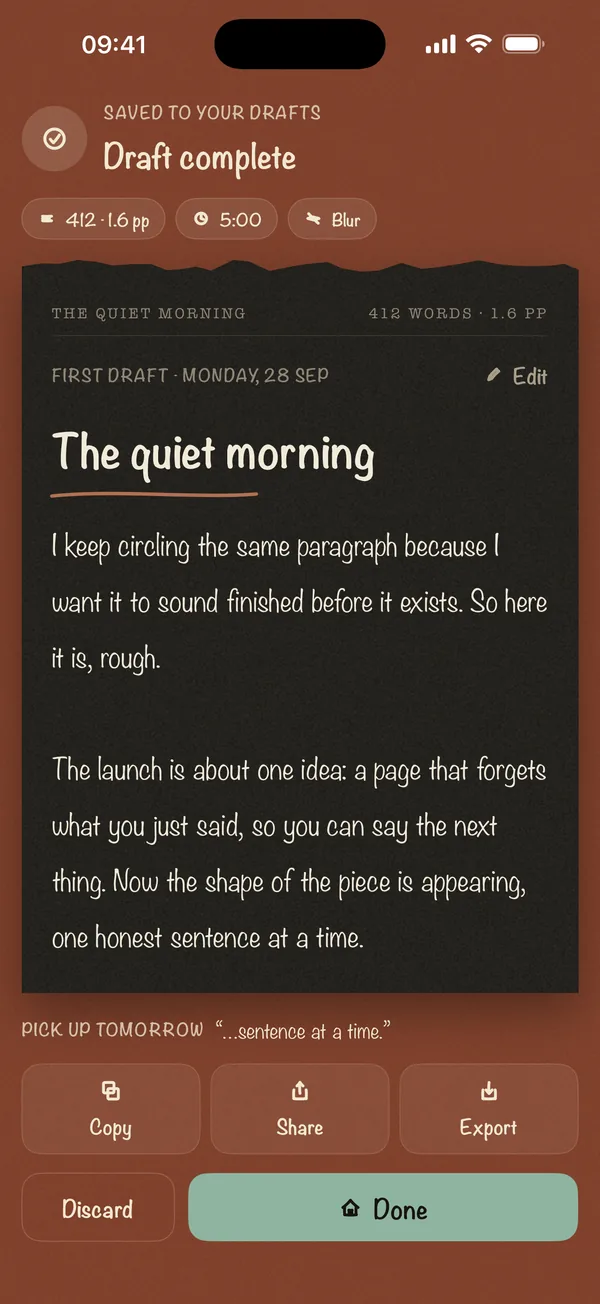
- No rereading. The single biggest leak in any sprint is scrolling up "to check something." Hiding the earlier text fixes it. Blind Draft's Blur mode softens each line once you move past it.
- A visible count. Seeing the word count go up keeps you moving.
- A next step. End each sprint by writing one line about what comes next.
Sprints vs freewriting
Freewriting is for generating ideas, so the output is often thrown away. Sprints are for the real draft, so the output is kept. The rules are similar: don't stop, don't edit. The difference is the target. See what freewriting is for the full comparison.
Common mistakes
- Sprinting too long too soon. A 45-minute "sprint" is just a writing session. Keep it short so it stays intense.
- Checking the timer. Hide it, or put the device face down.
- Editing during breaks. Breaks are for standing up, not for polishing the last sprint.
- Not tracking. Write down each sprint's word count. It's motivating, and it tells you your real pace.
Frequently asked questions
What is a writing sprint?
A writing sprint is a short, timed burst of focused writing on one piece, usually 5 to 25 minutes, with no editing until it ends.
How many words can you write in a 25-minute sprint?
Most people write 500 to 750 words in 25 minutes once they stop editing. Fast typists drafting familiar material can reach 1,000.
Are writing sprints good for students?
Yes. Sprints help with getting essays started, especially under deadline. Ten minutes of nonstop drafting usually beats an hour of planning the perfect introduction.
Can I do writing sprints on my phone?
Yes. A phone is fine for sprints if notifications are off. Apps that combine a timer, a word goal and hidden earlier text, like Blind Draft for iPhone and iPad, are built for exactly this.
The bottom line
Writing sprints are the easiest way to make steady progress on any draft: one piece, one timer, write forward, stop. Start with 5 or 10 minutes and build up. To keep from rereading mid-sprint, run your sprints in Blind Draft, where the timer, the word count and the blur are built in.