To finish a first draft, define "done" as complete, not good. Set a daily word or time target, write forward from wherever you stopped, mark gaps with notes instead of researching, and don't reread from the beginning until the last scene or section exists. Then edit.
Unfinished drafts tend to look alike: a strong opening, a careful second section, then nothing. The writer didn't run out of ideas. They kept going back to the start to make it better, and the end never arrived.
This plan works for an essay, a blog post, a short story or a novel. Only the numbers change.
Step 1: Redefine "done"
A finished first draft is one that goes from beginning to end. It can be clumsy, repetitive and wrong in places. If every section exists in some form, it's done.
Write that definition down. You'll need it on day three, when the draft feels terrible and you're tempted to start again.
Step 2: Make the goal embarrassingly small
Big goals ("finish the book this month") don't tell you what to do today. Small goals do:
| Project | Daily target | Rough finish time |
|---|---|---|
| 1,500-word essay | 300 words | 5 sessions |
| 5,000-word short story | 500 words | 10 sessions |
| 50,000-word novel draft | 1,667 words | 30 days |
| Newsletter issue | 15-minute sprint | 1 to 2 sessions |
300 words takes most people 10 to 15 minutes once they stop editing. That's small enough to do on a bad day, and bad days are what decide whether a draft gets finished. To work out the daily number for your own project and deadline, use the word count goal calculator; for a sense of how long your kind of book usually runs, see how many words is a novel.
Step 3: Write forward only
Start each session where the last one stopped, not at page one. If you must reorient, read only the last paragraph you wrote, then continue.
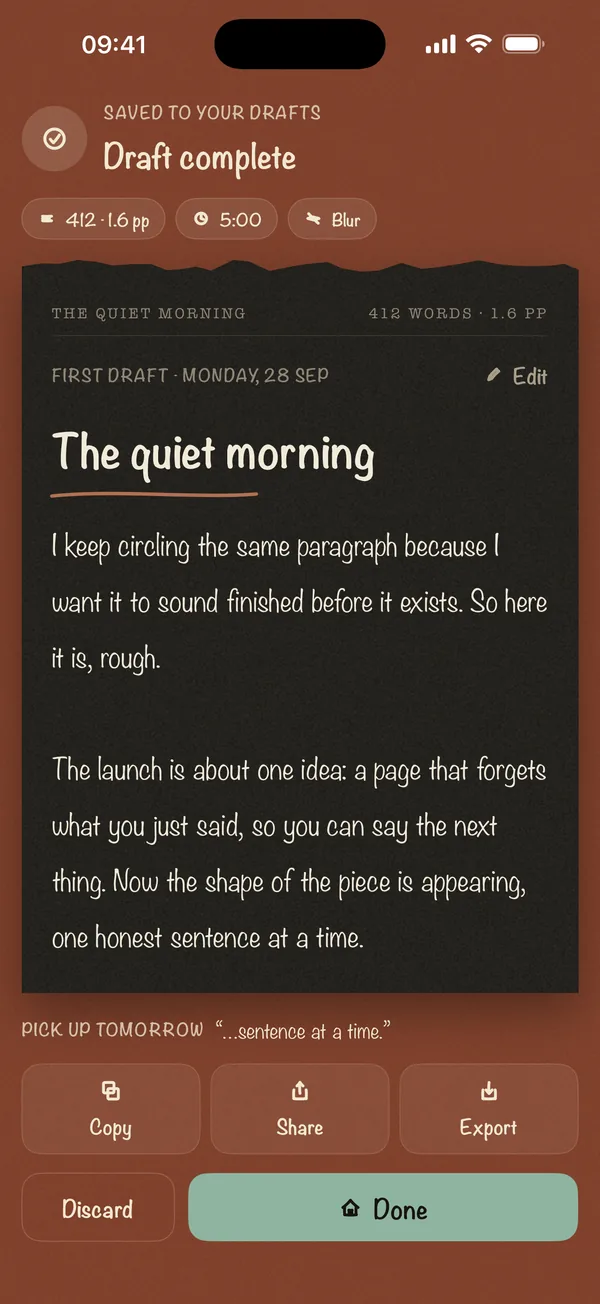
This is the rule people break most often, and it's the one that matters most. Rereading from the top turns every session into an editing session. If the urge is too strong, take the option away: write somewhere that hides earlier text. Blind Draft blurs each line as you move past it, so the only thing you can work on is the next sentence.
Step 4: Mark gaps instead of filling them
When you hit something you don't know, like a date, a name, a statistic, or how a scene should resolve, write a bracketed note and move on:
[TK: year the factory closed][SCENE: they argue, she leaves][BETTER EXAMPLE]
Each note is a promise to your editing self. Research during a draft is one of the most reliable ways to lose an afternoon.
Step 5: Use sprints for the hard middle
The middle of a draft is where momentum dies. The opening had energy and the ending is still far away. Short timed writing sprints carry you through it: 10 minutes, write forward, stop, take a break, go again. Two or three sprints a day add up quickly.
Step 6: Stop when it's done, not when it's good
When you reach the end, stop. Don't do a "quick polish pass" on the same day. Let the draft sit for at least a night, then read it all the way through before changing anything. You'll see its real shape, and many of the problems you worried about will turn out to be small.
Common mistakes
- Restarting from scratch. A new opening feels like progress but resets the clock. Finish the bad version first.
- Outlining forever. An outline helps, but it isn't a draft. Cap outlining at one session.
- Waiting for a free day. Fifteen minutes on an ordinary day beats a free Saturday that never comes.
- Sharing too early. Feedback on half a draft pulls you back into editing. Share once it's finished.
Frequently asked questions
How long should a first draft take?
It depends on length and how much time you have each day. At 300 words a day, a 1,500-word essay takes about five sessions and a 50,000-word novel about six months. At 1,667 words a day, a 50,000-word draft takes 30 days.
Should I edit my first draft before finishing it?
No. Editing before the draft is finished is the most common reason drafts don't get finished. Fix only what stops you continuing, like a plot point you now know is wrong. Leave a note for everything else.
What if my first draft is terrible?
That's normal and expected. Anne Lamott's Bird by Bird makes the case that bad first drafts are how good writing gets made. A terrible finished draft can be edited. A perfect half-draft can't.
How do I stay motivated to finish?
Track output, not quality: words written or sprints completed. Seeing the number go up each day is more motivating than judging whether today's pages were good.
The bottom line
You finish a first draft by lowering the bar to "complete," writing forward in small daily chunks, and not rereading until the end exists. If rereading is your weak spot, write somewhere that hides it. Blind Draft blurs or hides the text behind your cursor and reveals the whole draft when the sprint ends.